Having heard about Central Saint Martins through his art teacher, Shareef was already familiar with its reputation, but it was his teacher’s encouragement that led him to join the Saturday Club there.
Through the Club, Shareef discovered printing techniques he’d never had access to before, and a more collaborative way of working that reshaped how he thought about making things. The experience introduced him to graphic design as a career path he hadn’t previously considered, having thought of himself until then as more of a craftsperson than a designer.
Now a part of Makerversity’s Black Makers and Designers Residency at Somerset House, the very building where National Saturday Club holds its Summer Show, Shareef reflects on how the Club shaped his practice and continues to influence his work today, including a current project exploring heritage and identity through Afro hair and design.
This is Shareef’s Saturday Club story…
“The moment that’s stayed with me most from my Saturday Club days isn’t really one event, it’s a room, the printing room. I’d never done a lot of printing processes before. One week we were introduced to screen printing, lino cuts, that kind of thing- a lot of printing that isn’t available if you don’t have the facilities for it- and a lot of schools that aren’t art-focused, mine included, just don’t have that. It opened my eyes to different ways you can use found materials to make art.
Screen printing is the one that followed me the furthest. I still use it in pretty much every project I make, through my degree at Central Saint Martins, and now, in different forms.
I wasn’t supposed to end up in that printing room at all, really. It was my art teacher who put me forward for the Club, she’d taught me since Year 7, knew my development, and felt the school’s resources were a bit limited for how much I loved art, even in my spare time. I hadn’t heard of National Saturday Club before that. But if I had known about it myself, I’d definitely have taken part anyway. I wasn’t hesitant, because I’d have spent my Saturdays drawing at home regardless. It was a space to do something already familiar but also branch out and try something new.
I still remember walking into Central Saint Martins for the first time. It was very grand, one of the biggest design schools in the world. I felt like I’d somewhat accomplished something even on that first day I stepped in, and I could see myself getting into it in the future.

What I didn’t have yet was the word for what “it” was. Growing up in a creative household, I was always encouraged to express myself through art, but back then I’d have thought of myself as more of an art designer, or a craftsperson, not necessarily a designer. The Club is what first opened my eyes to design and craft as a genuine career path and even techniques and directions I’d never have considered before. And underneath the techniques, it taught me a different way of thinking altogether: to work collaboratively. That’s probably the main thing I still carry today; you need to work very collaboratively, especially if you want your design to make an impact on society, even a small one.

So, when I left the Club, my next step still felt like it would be something closer to fine art. What shifted things was work experience at an advertising agency; that’s where I started to see myself merging design and art rather than picking one, and where I finally landed on graphic design. Graphic Communication Design felt like the obvious route from there: a way to translate a narrative into visuals, whether that’s through print, digital publications, or anything else. Coming back to Central Saint Martins for my degree wasn’t a given; I looked at other places too. It wasn’t the be-all and end-all, but I was already so familiar with the building, and I’d enjoyed my time there so much as a teenager, that it pulled me back.
That same idea of familiarity and seeing what it can hold is what my current project is built on. It started as a publication for my end-of-year project at CSM: I was looking at how a singular object can mean completely different things to different people. I interviewed around six people across London, different ages, different backgrounds, about their favourite comb and what it meant to them. For some it was purely functional; they didn’t care how it looked, just how it worked. For others it was more like memorabilia, passed down through family, carved or crafted in a specific way that evoked real emotion. I wanted to hold both of those truths at once.
When I was offered the Makerversity residency, I saw a chance to take it further. I made the comb from wood specifically, as a deliberate material homage, even though the shape itself isn’t a traditionally Afrocentric one. What I’m really trying to get at is a wider point about care. I wanted to show how much thought and intention can go into an everyday object, especially something like an Afro comb, which doesn’t always get treated as more than purely functional. I wanted mine to be both functional and wearable, like something you can style your hair with but also loop onto a belt or wear as an accessory. Just have it be a bit more fun, with a bit more thought put into it.
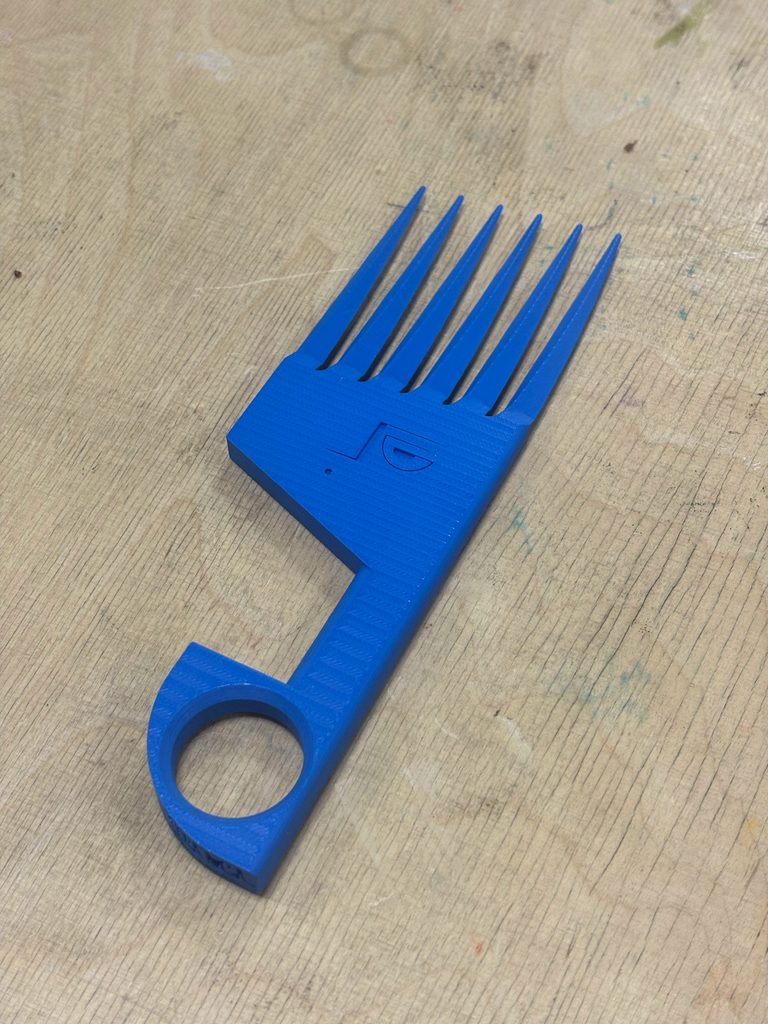


Being part of Makerversity’s residency has pushed me somewhere new, more hands-on, more craft-focused than my graphic design background usually takes me. But honestly, it comes back to the same thing the Club gave me first: it’s never just about the space. It’s the people, the connections, the community. If I think about what’s actually stuck with me most since those Saturdays, I will say it’s the way of working, and who you work with. Collaboration was central there in a way it hadn’t been before to me, and it still shapes how I approach problems now. I’m very, very grateful for both of those rooms.
To a 14 or 15-year-old who isn’t sure whether a Saturday Club, or design generally, is for them, I’d just say: TRY IT OUT. At that age, the future can feel a bit daunting, but it’s still really early. If it’s something you enjoy, put the effort in; anything you put in is what you get out. Having one Saturday a week can be that place and environment where you’re comfortable enough to learn something that ends up having a real effect on you. Nothing really shook my own commitment to it, if I’m honest. I was just happy to be there. These days, what inspires me most is a lot closer to home too, that is, the people around me. It’s inspiring watching people in your course, your university, your immediate bubble push on to do really big things, and seeing them slowly progress. It makes you want to go and do it yourself.
If I could change one thing in the world through design, it’d be making sure it reflects the people it’s for. There’s a lot within traditional Western design movements that I draw from and think we should learn from. For me, the goal is making work that genuinely relates to, and is understood by, the people it’s intended for. A single design tradition doesn’t really work for a city like London anymore, let alone most of the world. With how multicultural everything’s becoming, we need to look at how we merge, combine and build our own movements instead. It’s the same instinct that sent me into that printing room one Saturday morning nearly a decade ago, and the same one that’s brought me back to Somerset House since as a resident.”