When Tende first joined the Saturday Club, he described himself as shy, unsure of his talent, and uncertain whether drama could ever be a “real” career. Today, he studies at the Royal Central School of Speech and Drama, advocates for greater diversity in the arts, and has challenged senior leaders at TikTok about youth mental health and digital responsibility.
In between those milestones were moments of grief, self-doubt, validation, representation, and the quiet building of confidence. The kind that grows when young people are given space to explore their creativity without judgment.
This is Tende’s Saturday Club story.
What sparked your interest in joining a Saturday Club?
I was doing GCSE drama at my school in Oxford when my drama teacher told us about this opportunity to do more drama outside of class. Drama lessons were quite short, but it was always my favourite subject.
I was nervous to apply because I don’t usually do many extracurriculars and I didn’t know anyone else who was doing it. So my best friend and I both applied and we both got in, which was amazing. If my drama teacher hadn’t encouraged me I probably would have been too nervous to apply.
I’ve always loved acting and being creative but I was quite a shy person back then. I was interested in performance, but didn’t think I was particularly talented in it or confident enough to perform in front of people.
No one in my family works in anything creative, so it felt like new territory. I didn’t have anyone to say, “These are the ways you improve ” or “This is a viable career path.”
The fact that the classes were going to be taught by students at the Oxford School of Drama really inspired me. I remember thinking, I can speak to people who are actually trying to pursue this as a career. When you’re 14 or 15, that’s incredibly powerful.
Was the Saturday Club different from drama at school?
Very different. At the Saturday Club, I felt like I was learning real, practical skills to improve as an actor. GCSE drama can be quite theoretical and focused on grades, whereas this was about passion. It was new and refreshing to explore something creatively without being marked on it.
We did a lot of devising and learned how to create our own pieces. We even worked on Shakespeare, which I’d always thought was too complex for me. With guidance from the drama school students, we broke it down and performed the scenes in a way that made it feel accessible.
The biggest difference was that we talked about what drama school actually is and how you pursue acting beyond GCSE. That simply wasn’t discussed at school.
At my school, not many people doing drama looked like me or came from a similar demographic. I thought it wasn’t a space I’d be welcomed into. The Saturday Club made those dreams so much more realistic by showing me that every day people are actually pursuing this.
Being in a room full of other young people because they love drama, not just for a grade, was special. I met young people who live in Oxford I would never have crossed paths with otherwise – and I’m still in touch with many of them!
Are there any moments from your time at the Saturday Club that stand out?
Two moments really stay with me.
We performed Waiting for Godot, and we invited our families. I had never acted in front of my family before. I’d always said it was too embarrassing and was incredibly nervous.
Afterwards, my mum said, “Whoa, I didn’t know you could actually act. That was crazy.” That validation meant everything. At first, I’d told the Club tutor I didn’t want to invite my mum, but she gave me the confidence to step on stage. That moment stuck.
The other was going to Somerset House in London and seeing our self-portraits exhibited. Seeing my name on a plaque was surreal. I’d never considered myself an artist. That experience that I got to share with my Club and family gave me so much confidence that this was something I could continue pursuing.
Did the Club change how you saw drama as a career?
Completely.
Before that, drama school didn’t feel realistic. I’d never had any formal training and it seemed like such an expensive world to enter. But being able to ask direct questions – “Is this even a realistic dream?” And hearing that it was possible made a huge difference.
At the graduation ceremony, seeing all the different Saturday Clubs from across the UK was eye-opening. There were so many young people, from so many backgrounds. I realised more people were interested in drama than I’d thought.
We also had honest conversations about rejection. The students from Oxford School of Drama normalised it. In my head, one rejection meant you weren’t good enough and should give up. They reframed it as part of the process, which helped me explain to my family that studying drama is a career choice, not just a hobby.
When the head of the drama school came in to lead a session and mentioned he also taught at RADA, my friend and I were freaking out. He was so open and generous with advice. It was surreal – speaking to someone so respected, who treated us as equals, changed how I saw myself and gave me the confidence to apply to drama school.
You then went on to study abroad and then at drama school. Tell us about life after the Saturday Club.
There were a lot of dramatic shifts happening in my life at that time. The month before I joined Saturday Club, my dad unexpectedly passed away. I was determined not to let his passing make me feel like I’d fallen behind everyone and define what people expected from me.
I applied to UWC – an international group of schools focused on peace and sustainability. It’s where both my parents met at 16, so it felt full circle. I was quite secretive about applying because I wasn’t sure if I’d go. Everyone assumed I wouldn’t be able to leave home or that I’d never travel that far. I ended up moving to UWC Pearson in Canada by myself after my GCSEs and spent two years there.
Even while I was abroad, I remembered the conversations I’d had at Saturday Club. When I graduated two years ago and started applying to universities, I reached back out to some of the Oxford School of Drama students for advice.
Eventually, I was accepted to the Royal Central School of Speech and Drama.
What has your experience at drama school been like?
In my course, I’m the only Black boy in my entire three-year degree programme.
I mentioned it to the principal on the first day. I said, “There are very few Black people here, and that’s concerning, especially in central London.” That pushed me to become a student ambassador, trying to reach younger people and help them to apply.
If I hadn’t gone to Saturday Club, I wouldn’t have even thought about applying to drama school, it can feel so unattainable. That’s something I’m still actively doing now, trying to spread the message: you can come to drama school, please, we need more diversity here.
People sometimes say, “Well, those communities just don’t apply.” But I know my best friend, who went to Saturday Club with me, is an amazing actress and singer, I wish I could sing like her. I know incredibly talented people who didn’t apply because they lacked confidence or didn’t see it as a sustainable career path. There’s so much talent that goes unrecognised.
That’s why Saturday Clubs are so important, especially because it’s free. Drama training costs so much money. I’m often asked, “Have you not done this specific programme or paid for this course?” and I’ve had to say I didn’t have the financial means to afford that type of drama education. Since leaving the Saturday Club, a lot of my work has been focused on advocacy.
Did you develop specific skills at the Saturday Club that you still use today?
Confidence, definitely – patience and awareness.
When I first arrived at the Club, I remember thinking everyone felt very different from me. I wondered how it would work with us having to collaborate. I quickly realised that I was projecting my anxiety I had about performing. I learned that I had so much to learn from others, and hopefully, people learned from me too.
We had discussions around accessibility in the arts. Some students were autistic and I got to learn what performing meant to them. It opened my eyes to different ways you can make performance and theatre more accessible to someone with different learning capabilities or needs.
I often thought, “Oh, I’m the most aware of everything, I’m so progressive.” but I realised there are systemic things in the arts that don’t enable everyone to access them in the same way.
Hearing about different people’s needs and how they were managed at the Club was really valuable. It made me self-reflect and learn patience and consideration. The experience shaped how I move through creative spaces now and advocate for people who might not feel represented.
You are part of TikTok’s Global Youth Council, where you discussed topics such as mental health and digital responsibility. What has that taught you?
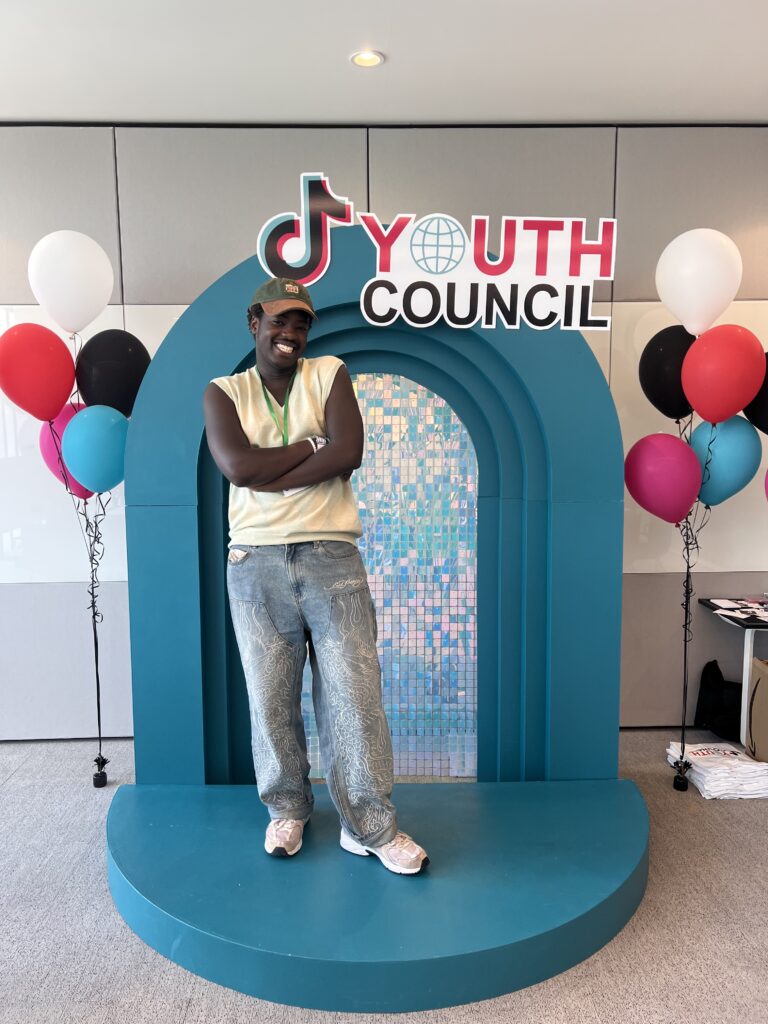
I was one of the first members of the TikTok Global Youth Council. In our second meeting, the CEO of TikTok joined. I remember thinking, In what world would we ever be in the same conversation?
The Saturday Club really gave me confidence to be in spaces where I might feel uncomfortable – and I felt like I had something to say. So I directly asked him whether he felt responsible for the teen mental health crisis and when platforms prioritise profit over mental well-being, how can we even have this forum to discuss issues of mental health?
Mental health can affect anyone.
It worries me when people say that they’re not influenced by what they see online because misinformation spreads quickly and things that aren’t true are easily presented as factual. The idea of public opinion dictating whether something is true or not is dangerous.
At the same time, social media gives young people a voice. It gives us a space to be in conversations where we’re usually told we’re not old enough to participate. If you can’t vote yet, you can use your platform to be part of the conversation.
I see social media more as a tool. I don’t think it’s inherently good or bad. It’s how people are using it. If we choose to use it to spread messages of hope and useful resources, it can be so important.
Whether it’s through posting online, being a student ambassador, or my role on the Youth Council, that’s something I’ve had to learn.
Do you see performance and storytelling as tools for advocacy and change?
Absolutely.
I was adopted from Uganda when I was six months old and grew up in a very white village in Oxfordshire. Even at school, up until secondary school, I was the only non-white person there. For me, performance was the first time I was able to see people in similar situations to me, people of other races doing incredible things.
Seeing a black person or people of colour on screen, doing amazing things, gave me confidence before I had it in real life. I entered spaces where I was the only person who looked like me. I’d seen it in movies, I’d seen it in plays. I always talk about how Beyoncé will always be a guiding figure in my life – I really believe that art and culture can shift narratives on how people see themselves.
Drama became a way where I could move beyond being labelled as “the only non-white child at this school.” When I played a character, I could express things that I didn’t have the confidence to say as myself.
The characters I was playing or creating had the aspirations I wanted to achieve. Now, with my own work, that’s something I try to carry forward. I want to create work that can shift perspectives in a positive way for people.
What advice would you give to young people considering joining a Performance&Theatre Saturday Club?
If you’re nervous, that’s a good sign. It means you care.
Everyone there is there because they love something creative, and creativity comes in many different shapes and forms. Go in ready to listen, to learn and to have your opinion changed. If you think you’ve mastered everything already, you won’t get the full benefit.
By being in a space with other creative people, you will inevitably improve your version of creativity. You’ll have ideas you can’t even think of now.
If there’s one thing you could change or improve in the world through creativity or storytelling, what would it be?
I’d like to remind people that, at the end of the day, we are all human beings, and we should treat each other with the same respect we give ourselves.
It’s very easy to get caught up in headlines or divisions or ways to self-segregate. Kindness goes a long way and sometimes it’s very easy to forget that it really starts with ourselves.
Interview conducted and edited by Suprina Thapa